
The industry behind swap bodies is one of Europe's less exciting asset classes — and that is meant as a compliment. It has been standardised for thirty years, regulated by EU law and supported by national funding programmes. The secondary market is liquid, depreciation is linear, the operational lessees are forwarders and logistics groups with long balance sheets. Exactly that monotony is what makes the sector interesting to institutional investors.
What changes in 2026 is the tailwind: three macroeconomic drivers act simultaneously on demand for crane-handleable units. Whoever is invested or considers entry benefits from a regulated industry transformation that is not driven by tech hype, but by EU regulation and accounting rules.
Swap bodies as an asset class
Swap bodies are an industrial tangible-asset class with low correlation to equity markets and a stable residual-value curve. For institutional investors, family offices and operating-lease platforms, four structural growth drivers underpin demand for KV-capable units in 2026.
Market structure
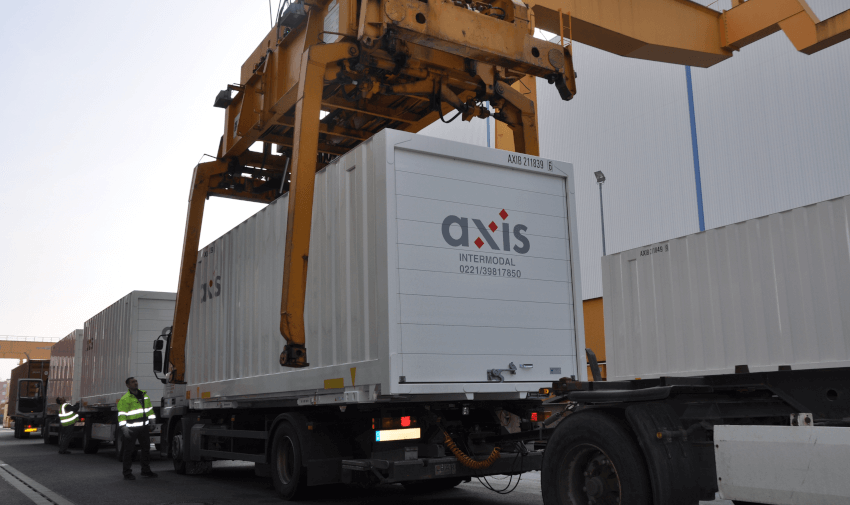
Estimates of the European swap-body fleet range, depending on methodology, between 250,000 and 400,000 units. The spread arises because some statistics include not only active KV bodies but also pure road units, storage bodies and older inventory. Three commercial pools dominate the rental segment in Europe; alongside them is a long tail of smaller providers and forwarder-owned fleets.
Four structural growth drivers
1. Modal shift is being politically forced
The European Commission targets a substantial shift of road freight to rail by 2030. The toll increase since December 2023 (CO₂ component) and the introduction of ETS 2 in road transport from 2027 push in the same direction — both raise the relative cost of pure road haulage and improve the economics of crane-handleable swap bodies in KV.
2. Parcel/express continues to grow non-linearly
Shipment volumes in the parcel/express segment in Germany remain above four billion per year. Growth is no longer in the percent-double-digits as in 2020/21, but stable and with pronounced seasonality — structurally supporting demand for rental capacity in Q4.
3. Telematics makes lettability visible
Real-time movement data is a precondition for scaling swap bodies efficiently as an operating-lease asset. Utilisation rates, locations and damage reports become quantitative steering metrics — analogous to container shipping. Anyone investing in fleet in 2026 should specify GPS telematics as default.
4. Residual-value stability via standardised form
EN 284 prescribes dimensions, corner pieces and lift edges so tightly that a 10-year-old swap body can be resold, repainted and re-rented without modification. The depreciation curve is therefore much more linear than for semi-trailers — a plus for any asset-backed structure.
Lease models
- Operating lease (standard)
- The investor (or platform) keeps ownership; the forwarder rents 12 to 60 months. Maintenance and UVV typically lie with the lessor; GPS and dispatch are optional.
- Sale & lease back
- A forwarder sells its existing fleet to an investor and rents it back. Effect: equity release at unchanged availability. Common in restructuring or growth phases.
- Spot / pooling rental
- Day- or week-based rental from a pool. Premium price, but no commitment — ideal for peak loads and unforeseen promotional business.
- Finance lease
- Economically more credit than rental — relevant for forwarders who want balance-sheet activation.
Risks from an investor perspective
- Utilisation risk in recessions — historically above 80 percent across the cycle for the major pools, individual quarters can be weaker.
- Damage and repair costs on intensively used units — a mandatory item in any due diligence.
- Regulatory shifts for standard revisions (EN 284) or KV funding — stable so far, but not guaranteed.
- Residual-value assumptions — for body types with limited rail eligibility, re-lettability and residual value drop noticeably. Specification matters.
More on practice: Swap bodies in the fleet. Current market briefing: Axis Insights #1.