
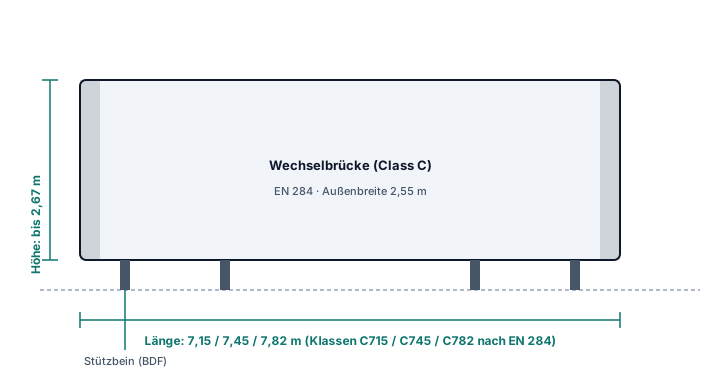
A swap body (also swap container, Wechselbehälter, Nadwozie wymienne; Class C under EN 284) is a standardised, demountable load body for freight transport, designed to be lifted off lorries or rail wagons. It connects road and rail without the freight ever needing to be transhipped — the operating principle of combined transport (KV).
Unlike the ISO container, a swap body has four foldable support legs (the BDF system) and can be set down by the driver alone, without a crane. It is built lighter — at the cost of being neither stackable nor sea-worthy — and is therefore a specialised tool for European inland logistics.
PhotoStanding
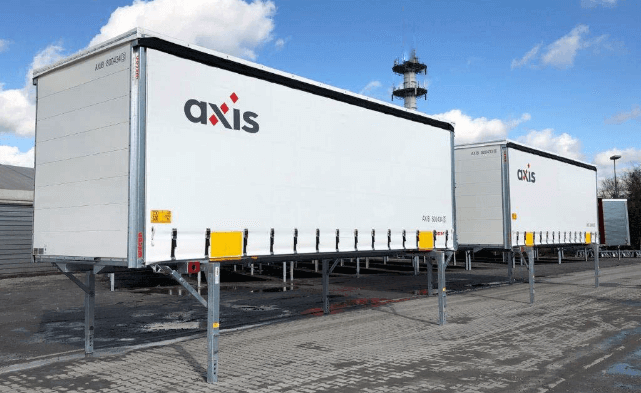
Photo: Axis Intermodal Deutschland GmbH.
Classes under EN 284
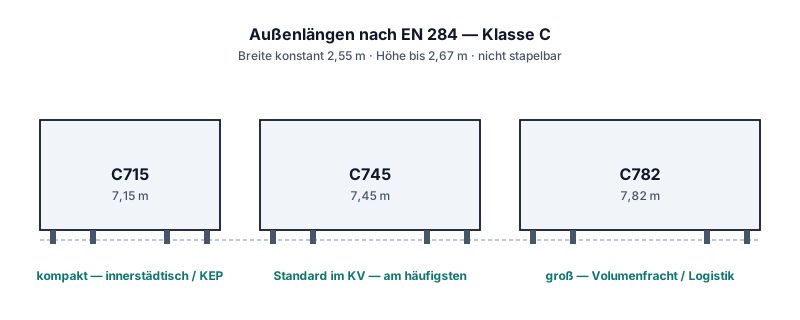
The European standard EN 284 defines Class C swap bodies in three standardised outer lengths, marketed under the codes C715, C745 and C782. Outer width and height are uniform across all three so that the BDF lorry interface fits any of them.
| Code | Outer length | Outer width | Outer height (max.) | Typical use |
|---|---|---|---|---|
| C715 | 7.15 m | 2.55 m | 2.67 m | Urban runs, parcel/express (KEP), compact tours |
| C745 | 7.45 m | 2.55 m | 2.67 m | The KV standard — by far the most common |
| C782 | 7.82 m | 2.55 m | 2.67 m | Volume freight, groupage, logistics service providers |
BDF — how the drop sequence works
The BDF system is the standardised mechanical interface between the carrier vehicle and the swap body. It allows the body to be set down without a crane, in three steps that take well under two minutes for a trained driver:
- Approach & secure: the lorry pulls in under or with the body at the drop location.
- Deploy support legs: four corner legs are extended mechanically or pneumatically; the body is raised slightly off the chassis.
- Lorry drives clear: the chassis is lowered and the lorry drives out from under the body, which now stands free on its legs.
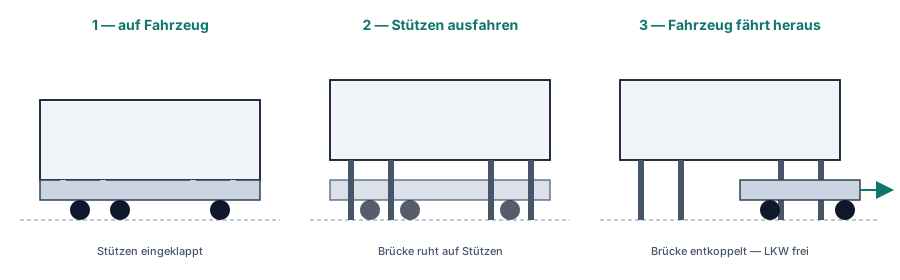
The same operation runs in reverse for pick-up. Centring cones on the chassis guide the body into the right position automatically — a key reason the operation is reproducible and driver-independent. This is the lever behind drop-and-hook models in stockless logistics: vehicle and body work uncoupled, asset utilisation rises sharply.
PhotoMaintenance
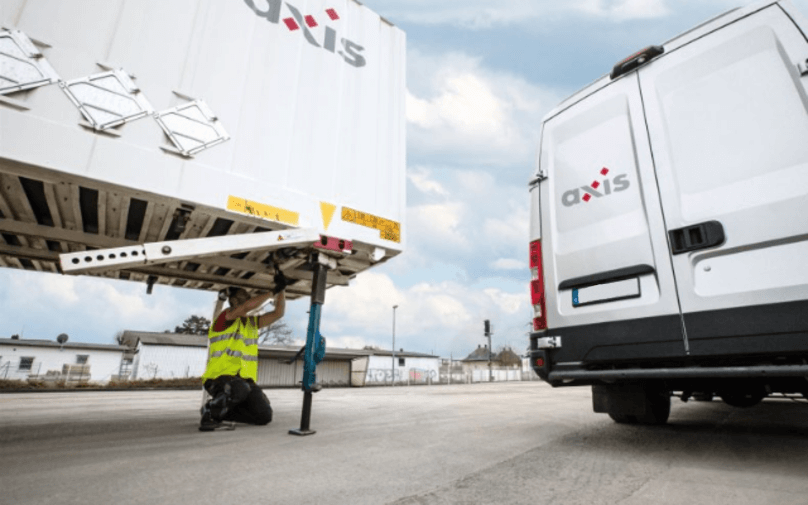
Photo: Axis Intermodal Deutschland GmbH.
In combined transport
In combined transport, swap bodies switch between rail and road — typically at a KV terminal where a portal crane or reach-stacker lifts the body between the rail wagon and the lorry. The lift edges along both long sides of the body are standardised, so any spreader of any operator at any European terminal will fit.
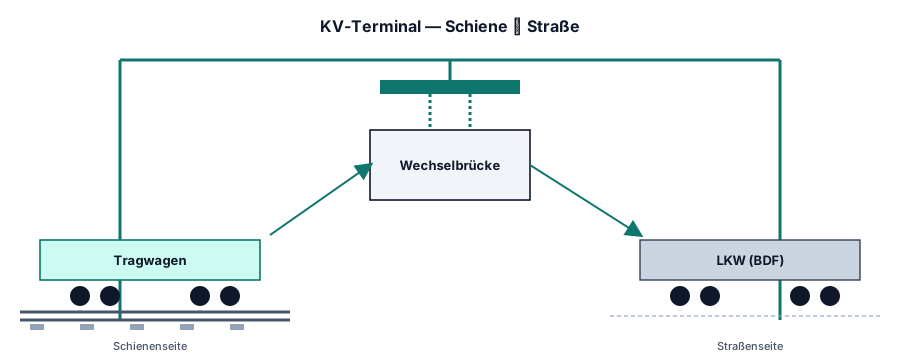
The economic logic is straightforward: the long-distance leg runs on rail (energy- and CO₂-efficient), the last kilometres to the consignee run by lorry — and the modal change at each end takes minutes, not hours.
PhotoRail
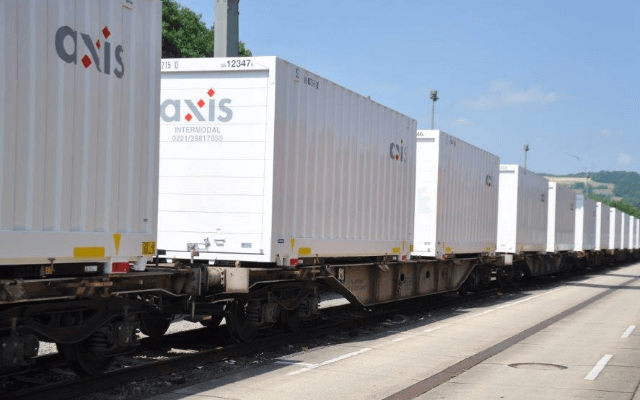
Photo: Axis Intermodal Deutschland GmbH.
Swap body vs. ISO container
Both are intermodal transport units (ITU), but they answer different questions.
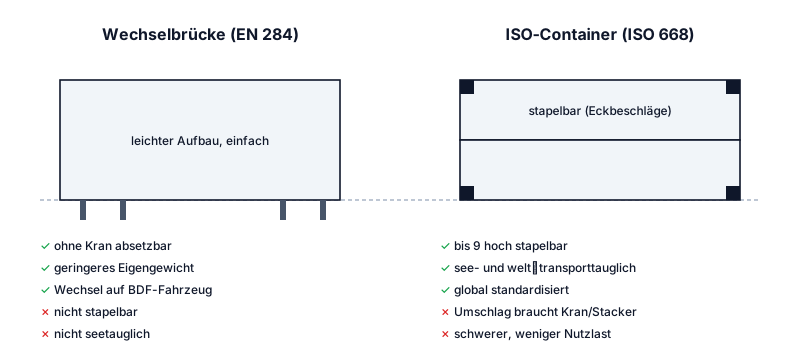
Practical rule: swap bodies dominate inland European combined transport (rail + road); ISO containers dominate intercontinental flows (sea + road + rail). On the major KV corridors — Hamburg–Milan, Rotterdam–Warsaw, Antwerp–Halle, Cologne–Verona — both run side by side on the same wagon.
„On relations beyond 300 km, the economics currently tip in favour of rail — provided the units are craneable."
Advantages at a glance
- Fast modal change: one- to two-minute transfer between truck and rail without touching the cargo.
- Decoupling of body and vehicle: the truck rolls on while the swap body is loaded or unloaded — utilisation goes up, idle time goes down.
- Higher payload: significantly lighter than a comparable semi-trailer or container — more tonnes per run.
- Capital-efficient: simple construction, lower acquisition and maintenance cost than a container or trailer.
- Climate advantage: the rail leg saves around two thirds of CO₂ emissions per tonne-kilometre versus pure road transport (typical empirical value from European combined-transport studies).
Limits and operating conditions
- Not stackable — unlike containers, swap bodies cannot be stacked vertically in the terminal, which ties up yard space.
- Not seaworthy — the construction is not designed for ocean-going loads; outside of Europe, containers dominate.
- Track gauges and loading gauges on rail trunk lines must match — in special cases (for example between standard and broad gauge at the Polish eastern border) compatible pocket wagons or an additional transhipment are needed.
The swap body is therefore a tool for a clearly defined application field — the intra-European corridor between industry, distribution centre and consignee. Its strength lies in the speed of the modal change and in the separation of vehicle and body.