
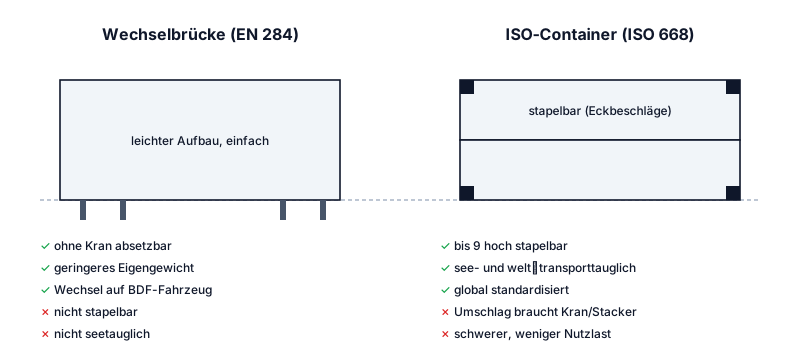
How does a swap body differ from a container?
Both are standardised load units, but they answer different needs. The swap body (EN 284 Class C) is designed for inland European rail/road transport: it is lighter and can be set down without a crane via support legs — but it is not stackable and not sea-worthy. The ISO container (ISO 668) is more robust, stackable and built for global transport including sea freight.
Which classes and lengths exist?
The market is dominated by Class C per EN 284 in three outer lengths: C715 (7.15 m), C745 (7.45 m, the KV standard) and C782 (7.82 m). Outer width is uniformly 2.55 m, outer height up to 2.67 m. Classes A and B (shorter and narrower swap containers) play only a niche role today.
How is a swap body set down — and how long does it take?
Via the BDF system: four corner legs are deployed, the body is raised slightly, the chassis is lowered — and the lorry drives out from under the free-standing body. Trained drivers complete the operation typically in under two minutes; pick-up runs at similar speed. No crane required.
Can swap bodies be stacked?
No. The construction is optimised for weight saving and ease of handling; stacking like ISO containers is not envisaged. In KV terminals swap bodies are parked single-tier — which binds more parking area than a comparable container fleet.
Are swap bodies sea-worthy?
Generally not. The standard construction is not built for the mechanical loads of high-sea voyages (stack pressure, salt water, lashing). For intercontinental transport with a sea leg, ISO containers are used instead.
What are the advantages of a swap body over a semi-trailer?
It is significantly lighter and usually cheaper than a crane-handleable semi-trailer — yielding more payload per tour and lower capital tie-up. For pure rail-road traffic without a port leg, the swap body is therefore the most economical load-unit concept. For continuous lorry tours without a rail leg, the semi-trailer is more flexible.
What payload can a swap body carry?
It depends on the empty weight of the specific body and the gross weight of the carrier. Standard C745 bodies typically weigh 1.5 to 2 tonnes empty — typical payload sits between roughly 16 and 22 tonnes, depending on tractor and national axle-load rules. For a concrete tour the manufacturer's data and national axle-load regulations are decisive.
Who regulates and standardises swap bodies?
The central standards are EN 284 (dimensions, Class C construction) and supplementary UIC specifications for rail compatibility. At EU level, Directive 92/106/EEC defines combined transport. Industry institutions include UIRR on the operator side and national supervisors such as the German BAG (Federal Office for Logistics and Mobility) for market observation.