
The regulatory framework for swap bodies in Europe
Swap bodies operate in a dense web of European and national rules — from EN 284 on body construction, through EU transport law, to the toll regimes of individual member states. Knowing the key norms lets operational decisions — from specifying new units to lease structuring — rest on a sound base.
Body construction and load unit
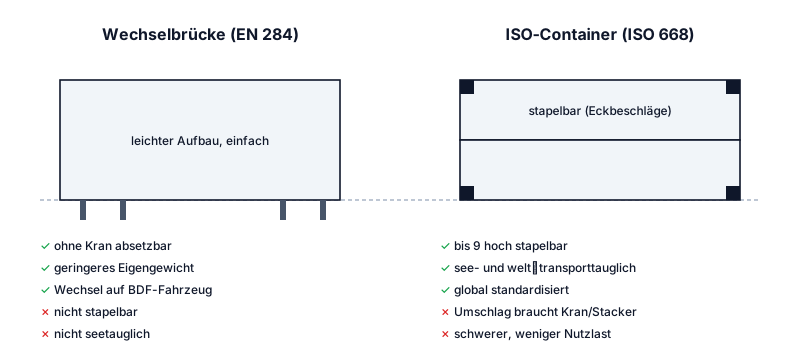
EN 284 — Class C swap bodies
European standard defining dimensions, construction and minimum requirements for Class C swap bodies — the dominant class in KV. Three standardised outer lengths (7.15 m / 7.45 m / 7.82 m), uniform outer width of 2.55 m, outer height up to 2.67 m. Also regulated: lift-edge geometry, corner reinforcements, support-system interface and the minimum loads the body must absorb.
EN 12642 (XL) — body strength
Standard for the structural strength of lorry and trailer bodies. The variant Code XL defines reinforced bodies in which wall and roof construction take part of the cargo securing. Increasingly default specification for swap bodies, because it reduces the securing burden on driver and shipper.
ISO 668 — ISO containers
International standard for freight containers (20-foot, 40-foot, 45-foot). Important for the boundary line: swap bodies are not ISO containers; they are an independent class. Not stackable, not sea-worthy, but more efficient to handle in KV.
Transport and environmental law
EU Directive 92/106/EEC — definition of combined transport
Legal basis for European KV. It defines when a tour qualifies as „combined transport" — typically requiring a rail or waterway main leg of at least 100 km airline distance and road pre-/post-haulage capped at 150 km. Tours that qualify can use national funding programmes and, in some cases, exemptions on lorry tolls or Sunday driving bans.
BFStrMG — German Federal Trunk Road Toll Act with CO₂ component
Since December 2023, the German lorry toll contains a CO₂ component. For Euro-6 vehicles, toll increases up to 83 percent compared with the pre-2023 level are documented depending on axle count. The additional revenues partly flow into rail financing — a politically intended shift of relative cost between road and rail.
ETS 2 — EU emissions trading in road transport (from 2027)
Directive (EU) 2023/959 extends the EU emissions trading scheme to road transport and to fuel for building heating from 2027. The additional CO₂ cost is added to the diesel price and hits lorry haulage directly. Swap bodies in KV therefore gain further relative economic advantage.
CSRD — Corporate Sustainability Reporting Directive
EU reporting obligation that, from financial years 2024/25, requires large companies to report on sustainability in audit-grade form — including Scope 3 emissions, i.e. transport. Industrial shippers must document their supply chains; that turns the KV share into an ESG steering metric.
Dangerous goods, customs and operational rules
ADR — carriage of dangerous goods
European agreement governing cross-border dangerous-goods transport on the road. For swap bodies: ADR-approved bodies meet enhanced requirements for construction, marking and documentation. In KV with a rail leg, the rail-equivalent RID applies in parallel.
Customs T1 procedure — cross-border KV with non-EU country
On rail line-hauls between EU and non-EU countries (Switzerland, United Kingdom, Turkey), goods are typically moved under the T1 transit procedure. Swap bodies are T1-capable when they are properly sealed against unauthorised access and customs sealing follows the regulations. AEO (Authorised Economic Operator) status considerably eases customs clearance.
DGUV V70 — UVV inspection
The German employers' liability insurance regulation for vehicles requires regular safety inspections of swap bodies — typically annual, more frequent in special use. Inspected: support system, lift edges, corner reinforcements and general condition. A passed UVV is a precondition for KV operation; missing or expired inspections lead to immediate decommissioning.
BMDV KV-funding directive
Funding programme of the German federal transport ministry, subsidising investment in KV terminals and KV-capable load units. Precondition: crane-handleable, KV-approved swap bodies and documented KV pre-/post-haulage. Comparable programmes exist in Austria, the Czech Republic, Poland and Italy.
More: Glossary · Markets · Asset class for investors