
Axle load
Maximum permitted weight per axle of a lorry or articulated vehicle under national road-traffic law. Determines the maximum payload of a loaded swap body and decides whether heavy-duty versions or standard variants are deployable.
AEO
Customs status for particularly reliable actors in the international supply chain. Simplifies customs processes in cross-border rail and KV transport, e.g. between EU and Switzerland or UK.
ADR
European agreement on the international carriage of dangerous goods by road. Swap bodies for dangerous goods must conform structurally and are marked as ADR equipment.
BDF system
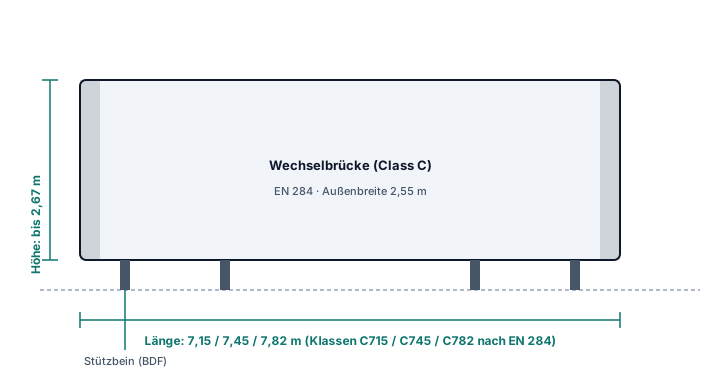
Standardised mechanical interface between carrier vehicle and swap body, allowing the body to be set down without a crane via four foldable corner support legs.
Rail line-haul
The rail segment of a KV tour between two terminals. Pre- and post-haulage are by lorry; the line-haul covers the bulk of the distance and delivers the economic lever of the modal-shift case.
Corner casting
Standardised corner block (typical on the ISO container) for receiving spreader grippers, twistlocks and stacking guides. Swap bodies have functionally similar but differently dimensioned lift edges and are typically not stackable.
BMDV
Germany's federal transport ministry, responsible for KV funding programmes, toll legislation, and national implementation of EU transport policy. A key actor for the funding of crane-handleable swap bodies.
BIEK
Federal industry association that publishes annual shipment volumes and market trends for the German parcel/express market — a key data source for market analysis.
Lift edge
Lateral steel edge along the long sides of a swap body, into which the spreader of a reach-stacker or portal crane locks to lift the body.
Code XL
Construction body standard under EN 12642 XL for curtain-side or curtain-slide bodies with enhanced structural rigidity — the body itself takes part of the cargo securing. Reduces the securing burden on the driver.
CSRD
EU sustainability reporting obligation that, from financial years 2024/25, also forces large industrial shippers to report Scope 3 emissions in audit-grade form. A central driver for KV demand.
Intermodal transport
Transport of goods in the same load unit (container, swap body or semi-trailer) across at least two transport modes, without the goods themselves being transhipped.
DGUV V70
German employers' liability insurance regulation requiring regular safety inspections on vehicles — including swap bodies. A passed UVV is a precondition for KV operation.
Drop-and-hook
Logistics concept where a lorry sets down a loaded or empty swap body (or semi-trailer) at the hub and immediately picks up another — without waiting for loading or unloading. A classic efficiency lever in parcel/express and groupage.
ISO container
Standardised steel container per ISO 668, with corner castings, stackable and sea-worthy. Common in 20-foot, 40-foot and 45-foot lengths (the latter for KV). The backbone of global port handling.
ETS 2
Extended European emissions trading scheme that, from 2027, covers fuels for road transport and building heat. Raises the relative cost of pure road transport and supports the economics of KV traffic.
ERA
EU agency for railway matters, based in Valenciennes, France. Publishes safety and interoperability standards for rail and KV; relevant for the approval of wagons and load units in cross-border traffic.
Eurostat
Statistical office of the European Union; publishes harmonised data on modal split, intermodal transport, tonne-kilometres and rail freight in the EU member states — one of the central sources for KV market analysis.
ITE
Umbrella term for intermodal load and handling equipment (containers, swap bodies, semi-trailers). Often used synonymously with ITU, with emphasis on the equipment side.
Eurostat database
Online database from Eurostat with harmonised transport statistics across EU member states — modal split, intermodal transport units, tonne-kilometres on road and rail. The most important public source for KV market analysis; transport data are bundled under "Transport".
ESG
Umbrella term for sustainability criteria in corporate evaluation. In logistics, concretely realised through CSRD and Scope 3 emissions; turns the KV share into an ESG steering metric and the swap-body market into a structurally demanded asset class.
Tachograph
Digital recording device in lorries above 3.5 tonnes, documents driving and rest periods. Critical in KV pre-/post-haulage where driving time can be tight and the driver must have set down the body before end of shift.
Piggyback transport
Form of combined transport where whole semi-trailers or swap bodies are loaded onto rail wagons. A traditional umbrella term in German industry usage, often synonymous with KV (rail-road).
Generation (swap bodies)
Industry term for the build vintage of a swap body. Current standard variants are the 4th and 5th generation, with improved support systems, longer lifetime and integrated telematics readiness. Determines residual value and re-lettability.
Hinterland
Geographical economic area served by a seaport (e.g. Hamburg, Rotterdam, Antwerp, Gdańsk) by rail, lorry or barge. KV traffic between port and hinterland is the highest-volume application for swap bodies in north-western and central Europe.
ITU
Intermodal transport unit — container, swap body or semi-trailer — that switches between transport modes without the contents being reloaded.
IFRS 16
International accounting standard for lease arrangements, in force since 2019. Determines how swap bodies under operating lease or sale & lease back are reported — directly affecting equity ratios and leverage metrics for forwarders and investors.
KV funding (BMDV)
Funding programme of the German federal transport ministry (BMDV) that subsidises investment in KV terminals and KV-capable load units. A key driver for the procurement of crane-handleable swap bodies.
Just-in-Time
Logistics concept delivering material exactly when needed at the production or distribution point — without buffer stock. Requires high punctuality and therefore reliable modal exchange in KV; a premium application for swap bodies.
Annual mileage
Sum of kilometres driven per year for a lorry or articulated vehicle — a key metric for toll calculation, maintenance and residual value. Swap bodies, by contrast, are counted not in kilometres but in turnarounds per year.
KEP
Umbrella term for the industry handling small shipments (typically ≤ 31.5 kg) in B2C and B2B. Germany again handled over four billion KEP shipments in 2024 — a central application for swap bodies in urban pre-/post-haulage.
Combined transport
Form of intermodal transport where the major part of the journey runs on rail or waterway and pre-/post-haulage by lorry are kept as short as possible — legally defined in the EU under Directive 92/106/EEC.
Direct KV
Combined-transport variant between a fixed shipper site and a fixed consignee site, often with rail siding and fixed train slots. Highly plannable, with high utilisation per swap body.
Corrosion protection
Coating and care measures protecting the steel structure of a swap body against salt water, road salt and weather. A key value-retention factor — bodies with insufficient corrosion protection lose residual value much faster than maintained units.
Toll regime
Distance-based charge for heavy-goods vehicles on federal trunk roads. Since December 2023 with a CO₂ component; depending on axle count and propulsion, toll rates rise significantly, improving the economics of KV traffic.
Loading gauge
Geometric envelope in which rail wagons, including their load, may move without touching tunnels, bridges or platforms. Critical for KV corridors — e.g. P400 for tall semi-trailers; standard swap bodies are less critical here.
Modal Shift
Politically and economically intended shift of freight volume from road to rail or waterway. A central concept of EU transport policy and a key structural driver for crane-handleable swap-body demand.
Modal split
Share of individual transport modes (road, rail, water) in total freight or passenger transport of a country or region. A key steering metric of transport policy.
Multimodal transport
Transport using several transport modes, where the load unit need not pass through them all unchanged. The boundary line to intermodal transport, where the same unit travels through all modes without reloading the goods.
Payload
Difference between gross combination weight and empty weight — the decisive metric for tour economics. A standard C745 swap body allows typical payloads of 16 to 22 tonnes, depending on tractor and national axle-load rules.
Operating Lease
Lease model where economic ownership stays with the lessor (investor / platform); the lessee (forwarder) pays usage rent and returns the asset at lease end. The standard model in the swap-body rental market.
Low-floor wagon
Rail freight wagon with a low loading deck, capable of carrying taller bodies (e.g. C782 or hi-cube containers) in KV. Important for corridors with restricted loading-gauge profile.
Reach-stacker
Specialised vehicle with an extending arm and spreader, used in KV terminals to transfer containers and swap bodies between lorry and rail wagon — an alternative to the fixed portal crane.
Pocket Wagon
Rail freight wagon with an embedded pocket to receive crane-handleable semi-trailers in KV. Specialised for trailer-on-rail concepts; for swap bodies, flat KV wagons of type Sgnss are normally used.
P400 loading gauge
Rail loading-gauge profile for combined transport that allows semi-trailers up to 4.00 m corner height above rail. An important precondition for trailer-on-rail concepts; less critical for standard swap bodies.
Q4 peak season
Seasonal peak in groupage and parcel/express in the fourth calendar quarter — Black Friday, pre-Christmas, promotional weeks. The spread between baseload and peak in many fleets is 20–35%; the main case for flexible pooling models.
Semi-trailer
Trailer without its own front axle, connected to the tractor via a kingpin. In KV, the so-called crane-handleable trailer (e.g. P400 profile) is an alternative to the swap body.
Pooling
Rental model with a shared body fleet, in which multiple forwarders flexibly access a common pool — typically week- or day-based. Smooths utilisation peaks and reduces the need for own equipment.
Residual value
Expected sales value of a swap body at the end of its useful life (typically after 12–15 years). Thanks to EN 284 standardisation and the liquid European secondary market, comparatively stable — a decisive metric in any lease calculation.
Support leg
One of four foldable legs at the corners of a swap body. Carries the body when set down from the lorry. Mechanically or pneumatically operated.
Return on Investment
Ratio of profit from an investment (e.g. an own swap-body fleet) to capital deployed. In the rental market typically expressed as gross yield per body (rental income minus running costs divided by acquisition value).
Rail
Railway as transport mode — in combined transport classically the line-haul between two terminals. More CO₂-efficient than pure road transport, but dependent on corridor capacity, track-access charges and loading-gauge profile.
Sale & Lease Back
Financing structure in which a forwarder sells its existing swap-body fleet to an investor and leases it back. Effect: equity release at unchanged availability. Increasingly demanded in current market conditions.
Spreader
Pickup device on a portal crane or reach-stacker that locks onto the lift edges of a swap body (or the corner castings of a container) and lifts the unit. Spreaders for swap bodies are standardised and fit across manufacturers.
Terminal (KV terminal)
Facility for transhipping intermodal load units between rail and road, equipped with portal crane, reach-stacker or mobile crane and staging areas for wagons and lorries.
Telematics
Umbrella term for GPS, motion and door sensors, often solar-powered, in swap-body rental fleets. Provides real-time location, utilisation data and damage alerts. By 2026 a baseline requirement in larger fleets and shipper tenders.
Track & Trace
Real-time location and status tracking of a swap body — typically via solar-powered GPS module with motion and door sensors. By 2026 a standard requirement in shipper tenders and insurance contracts.
TEN-T
EU-wide concept of a priority transport network covering rail, road, water and air — with defined corridors, nodes and expansion targets. Indirectly determines the location of KV terminals and therefore the sites at which swap bodies can be deployed efficiently.
TEU
Standardised container unit based on the 20-foot length. The standard counting metric for port handling and container movement statistics — typically referring to ISO containers. Swap bodies are counted in units, not TEU.
KV wagon
Specially constructed rail freight wagon for intermodal load units — e.g. Sgnss for containers and swap bodies, pocket wagons for crane-handleable semi-trailers.
Transport infrastructure
The whole of physical facilities for freight and passenger transport — roads, rails, waterways, airspaces, ports, terminals. In the freight sector increasingly divided into heavy (built structures) and light infrastructure (standardised load units and telematics); swap bodies belong to the light side.
UVV
Regular safety inspection of swap bodies (in particular the support system), legally required. Frequency, scope and documentation are governed by the German employers' liability associations — typically annual, more frequent depending on use.
Shipper
The party commissioning a transport — the industrial company, online retailer or wholesaler that ships freight. In KV increasingly ESG- and CSRD-driven, which structurally supports demand for crane-handleable swap bodies.
Turnaround rate
Number of transport cycles a swap body completes per time unit (typically: turnarounds per week). The most important metric for asset utilisation in the rental market and decisive for the gross yield of an own fleet.
UIRR
Industry association of European combined-transport rail-road operators. Publishes annual volume and market statistics for European KV.
Rail siding
Direct rail connection at an industrial plant or logistics centre. Allows direct KV without lorry pre-/post-haulage to the terminal — a premium concept in combined transport, often combined with own swap-body fleets.
Pre-/post-haulage
Road segments of a KV tour before and after the rail line-haul. Pre-haulage: shipper to terminal A. Post-haulage: terminal B to consignee. KV economics typically tip when combined pre-/post-haulage cost still leaves enough margin against the line-haul advantage.
Swap body
Standardised, demountable load body for freight transport, designed to be lifted off lorries or rail wagons (Class C under EN 284). Set down via four foldable support legs without a crane; not stackable, not sea-worthy.
Centring
Mechanical guide on the chassis that ensures the precise position of the swap body relative to the BDF system during pick-up. Four centring cones are standard; they make the pick-up reproducible and reduce wear.
Customs T1
Customs procedure for non-Community goods under the Community transit regime — relevant in cross-border KV with non-EU country (e.g. Switzerland, UK). Swap bodies can be cleared under T1, which makes corridor economics work across the EU external border.
Twin loading
Rail configuration in which two Class C745 swap bodies are carried together on a single KV wagon. The standard load profile for KV line-hauls; enables high utilisation per wagon and per train slot.
X-class wagon
Umbrella term for rail wagons whose UIC class identifier starts with "X" — typically service and inspection wagons for maintenance, rail grinding and surveying. In the KV context they appear as service vehicles on the corridors, less as carriers for swap bodies.
X-ray scanner
Stationary or mobile X-ray installation for non-intrusive inspection of intermodal load units at EU external borders, seaports and selected KV terminals. Swap bodies in cross-border KV (e.g. EU-CH, EU-UK) typically pass NII at customs checks; the standardised EN 284 form factor eases standard scanning.
Cross-border KV
Industry shorthand for KV traffic across EU external borders — primarily EU↔Switzerland, EU↔United Kingdom, EU↔Turkey. Requires additional documentation (T1 procedure, AEO status, possibly NII inspection). Swap bodies are X-border-capable when properly sealed and equipped with ADR/customs-compliant body variants.
Yard Management
Control of movement flows on logistics hubs and KV terminal yards — who parks where, when which swap body is picked up, which lorry gets which slot. Increasingly digitalised; container-level telematics is a precondition.
Year-on-Year
Statistical method comparing a metric (e.g. KV volume) with the equivalent prior-year period. Standard in quarterly and annual reports; relevant for market statistics and inventory analysis.