
Engineering of the swap body
A swap body is a tool that does exactly three things well: it carries load, it changes mode without a crane, and it stays liquid in the European secondary market for 12 to 15 years. Every design feature is optimised for one of those three jobs. Understand the engineering, and you understand the economic logic behind it.
BDF — the most important interface
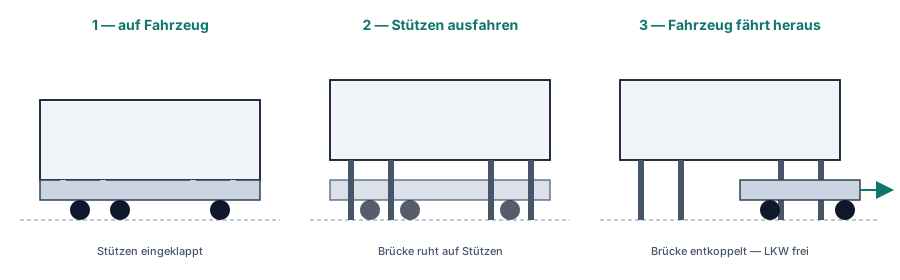
BDF is the standardised mechanical interface between carrier vehicle and swap body, a default in German and Central-European groupage transport since the early 1980s. It defines four points: pick-up height (1255 mm top edge of chassis), centring-cone position, locking mechanism and the lateral lift edges for reach-stackers and portal cranes.
Constructively, the system consists of the carrier vehicle (BDF swap rack or semi-trailer) and the swap body. Four centring cones sit on the vehicle, four matching pockets on the underside of the body. During drop, the four legs are deployed pneumatically or mechanically; the body rises off the chassis; the lorry drives clear. Pick-up runs in reverse — the centring cones automatically guide the body into the right position, which makes the operation reproducible and driver-independent.
Support legs — four variants
- Mechanical (crank) — lightest and cheapest variant; the driver winds the legs out and in by hand. Robust, almost no maintenance. The default in the rental market.
- Pneumatic — legs deployed using compressed air from the lorry's on-board system. Faster, less physical effort; somewhat more maintenance points.
- Hydraulic — for heavy-duty versions or very low ground clearance. Rare in standard swap bodies.
- Electromechanical — most modern variant, with control panel at the rear and status sensors. Increasingly seen in premium rental fleets.
Lift edges and corner reinforcements
The long sides of a Class C swap body carry standardised lift edges in steel, into which the spreader and gripper arms of the handling equipment lock. The exact geometry is defined in EN 284; any swap body from any rental pool fits any reach-stacker or portal crane in any European KV terminal.
The four upper corners carry corner reinforcements (not to be confused with the ISO container corner castings, which follow a different standard). They absorb impact loads during pick-up and prevent body deformation over the lifecycle. Swap bodies with damaged corner reinforcements lose residual value dramatically — they are no longer usable in KV because they cannot be lifted safely.
Body variants
- Curtainsider
- Default in groupage; side-opening curtains, fast loading and unloading. Code-XL curtainsider bodies take part of the cargo securing.
- Box
- Closed sandwich-panel box. Standard in parcel/express and for temperature-sensitive goods.
- Reefer
- Insulated box with refrigeration interface; niche, because reefer trailers are often more economical.
- Special bodies
- Tank, silo or container variants — small in volume, but important in industrial inbound.
Telematics — the digital interface
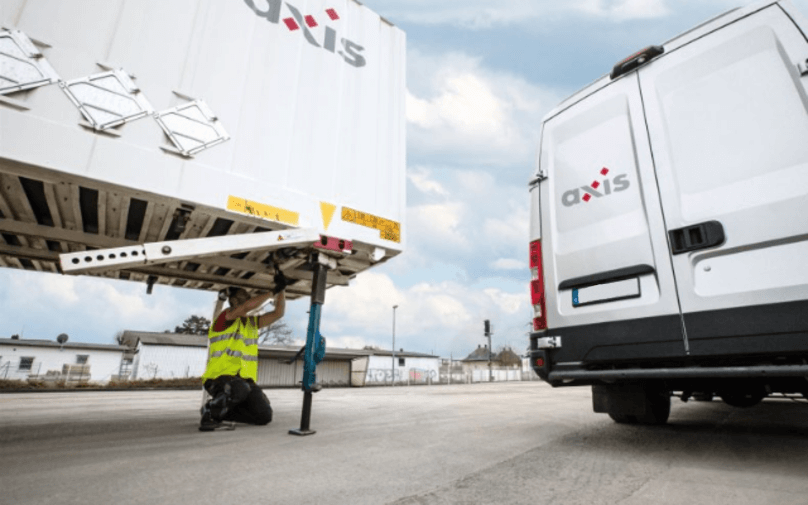
In 2026 the telematics interface is no longer a premium option but a baseline requirement. Three components belong in any standard specification for new units:
- GPS module with solar power — no cabling to the lorry, autonomous operation over the lifecycle of the body.
- Motion sensor for state changes (on lorry / parked / handover) — the data feed for utilisation statistics.
- Door sensor on box bodies — real-time indicator for loading/unloading times; increasingly demanded in shipper tenders.
This telematics turns a swap body, from the lessor's perspective, into a measurable asset: utilisation, locations, damage events become quantified. From the dispatcher's side, it reduces empty time by five to twelve percent according to industry experience values, because parked units no longer need to be searched for.
Going deeper: Glossary · Regulation · Markets